.png)

10 Health & Safety Tips for SAFETY MANAGERS
Infographic Transcription
Deaths
14
7,700 Injuries
DAILY IN 2017
Workplaces are generally safe...
BUT WE CAN DO BETTER.
Employers are responsible for slashing those startling numbers and keeping workers safe,
as outlined in OSHA's General Duty Clause. The pivotal passage states, in its entirety:
“Each employer shall furnish to each of his employees employment and a place of
employment which are free from recognized hazards that are causing or are likely
to cause death or serious physical harm to his employees.”
Safety managers can take hundreds of steps to ensure the health and safety of their workforce, so where should one start?
Here are 10 easy-to-follow tips for MITIGATING HAZARDS, AVOIDING OSHA FINES & IMPROVING SAFETY:
1 - Take Steps to Mitigate Hazards
Find out which hazards are present in your facility with a Job Hazard Analysis, and encourage a proactive culture of safety with near-miss reporting.
A Job Hazard Analysis (JHA) offers a systematic method for assessing hazards related to certain tasks— and taking steps to mitigate those hazards. Here are the steps for conducting a Job Hazard Analysis:
-
Identify a Potentially-hazardous Task to Analyze and Correct
-
Research and Describe the Task
-
Identify the Hazards, Triggers & Consequences Associated with the Task
-
Develop a Set of Controls to Improve Safety
Employers should also encourage near-miss reporting whenever they have a close call that could have resulted in injury, illness, or damage (but didn’t).
THESE INCIDENTS CAN PROVE DISASTROUS WHEN COMPANIES DON’T TAKE STEPS TOWARD IMPROVING SAFETY.
When workers report near-misses and close calls, they’re finding safety concerns before OSHA inspectors, determining the root causes of near-misses, and catching hidden hazards before they lead to accidents.
KEY STATISTIC:
A 2003 study conducted by Conoco Phillips Marine found that, for every fatality, there are an estimated 3,000 near-misses and 300,000 at-risk behaviors (such as skipping a safety step to save time).
300,000 AT-RISK BEHAVIORS
3,000 NEAR-MISSES
FATALITY 1
2 - Provide Proper Training
The Occupational Safety and Health Act of 1970 requires that employers provide a SAFE WORKPLACE, free of recognized hazards; OSHA has since outlined dozens of training requirements to help employees understand the risks and take steps toward the safest possible work environment.
These requirements cover a wide range of industrial safety, from performing welding and other hot work, to using cranes and derricks on a construction site, to safely operating forklifts in a warehouse.
Brochures & Booklets
Fact Sheets
Training Grants
Web-based Safety & Health Topics Resources
Outreach Training Program Courses
Posters
Wallet-sized QuickCards
GOOD TO KNOW
Effective training can keep workers safe on the job.
882,700 total days-away-from-work cases were reported in 2017
*According to the Bureau of Labor Statistics
3 - Keep Your Workplace Clean and Organized
OSHA offers little in the way of specific cleanliness guidance, but it’s good to keep a tidy workplace, just the same.
The 5S System offers one method for cleaning your workplace, organizing work areas, and establishing routines that increase productivity, efficiency, and revenue. Here’s why cleanliness matters—and how 5S can help:
IMPROVE EFFICIENCY:
Create standardized work procedures, and establish routines for accomplishing regular tasks
INCREASE ORGANIZATION:
Discard seldom-used and unnecessary tools, and keep important items in a common area
REDUCE ERRORS:
When workers know what to do— and how to do it—they are less prone to errors, mistakes, and mishaps
GOOD TO KNOW
Cleaning work areas and removing hazards can help cut the number of slips, trips, and falls.
227,760 Cases Involving Slips, Trips & Falls were Recorded in 2017
*According to the Bureau of Labor Statistics
4 - Establish Lockout/Tagout Procedures
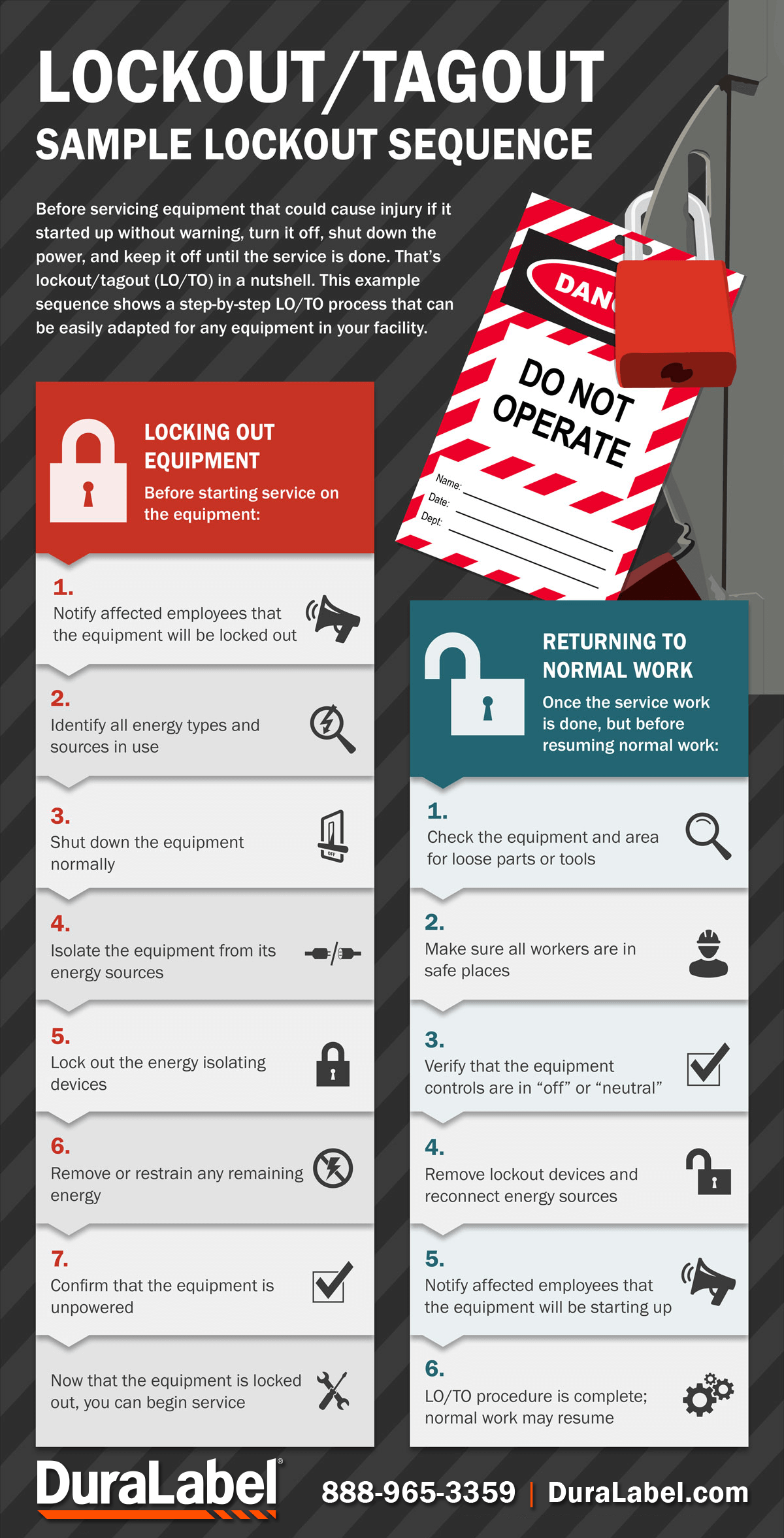
In many cases, workers must establish (and follow) a lockout/tagout (LO/TO) procedure before performing maintenance or routine upkeep on a piece of equipment.
Basic LO/TO procedure workers can follow to meet OSHA requirements for controlling hazardous energy:
- Notify all impacted employees that the
equipment will be locked out - Identify all energy types and sources
currently in use -
Shut down and isolate the equipment from its energy sources
- Lock out the energy-isolating
devices - Remove or restrain any remaining
energy -
Confirm the equipment is unpowered
Once the equipment is locked out & you’ve started service, take the following steps to resume normal work:
-
Check the equipment and area for loose parts or tools, and ensure all workers are in safe places
-
Verify the equipment controls are “off” or “neutral”
-
Remove lockout devices and reconnect energy sources
-
Notify all impacted employees that the equipment will start again, and return to normal work
10% Failure to follow proper LO/TO procedures accounts for nearly 10 PERCENT OF ALL SERIOUS ACCIDENTS in numerous industries.
5 - Be Ready for the Unexpected
You’ll want to be prepared in event of fire or another emergency. If a fire breaks out or the power goes out, will your workers know what to do?
Take steps toward improving fire safety with these tips:
Conduct a FIRE RISK ASSESSMENT to determine hazards and establish exit routes
Develop an EMERGENCY ACTION PLAN (EAP), with formal fire safety procedures
How else can you stay ready?
Have a spill kit on hand to contain, control, and absorb leaking fluids
Post and distribute facility maps, clearly marked with emergency exits, fire extinguishers, and egress paths
Maintain and provide standardized Safety
Data Sheets and container labels when hazardous chemicals are present
Ensure all outside exits, emergency exits, egress paths, and stairwells are clearly marked with phosphorescent signs, labels,
and floor marking
KEY STATISTIC:
According to the NFPA, U.S. fire departments respond to roughly 37,910 fires at industrial or manufacturing facilities each year. Those fires lead to, on average, 16 deaths and $1.2 billion in direct property damage.
37,910 FIRES YEARLY @ INDUSTRIAL FACILITIES
$1,000,000,000+ PROPERTY DAMAGE
16 DEATHS
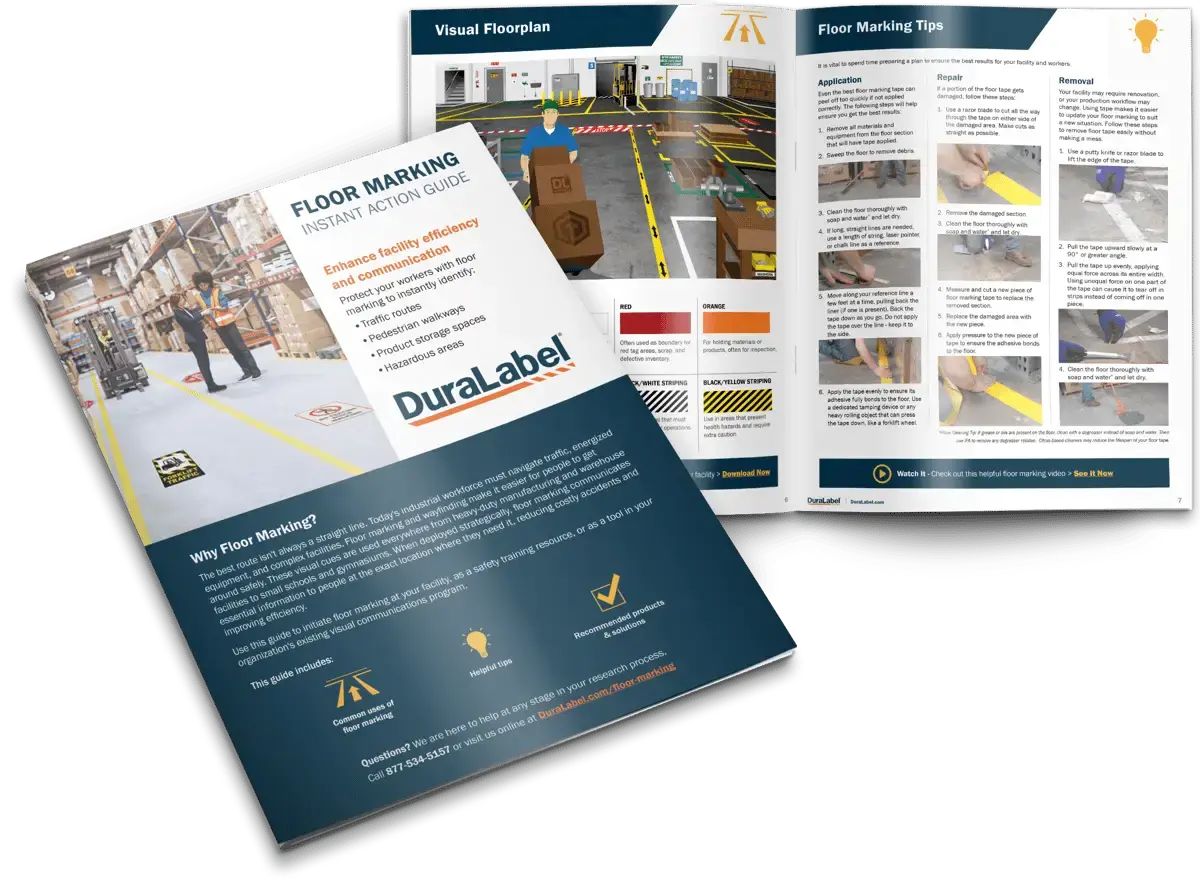
6 - Improve Traffic Flow and Safety with Floor Marking
As part of a safe work environment, OSHA requires clean surfaces. In its standard for walking-working surfaces (29 CFR §1910.22), the agency states: “Walking-working surfaces are maintained free of hazards such as sharp or protruding objects, loose boards, corrosion, leaks, spills, snow, and ice.”
Floor marking can increase warehouse safety through improved organization and efficiency. Here’s a look at how floor marking can help:
Establish aisles and paths to separate pedestrians, forklifts, and other hazards
Create storage areas for inventory, machines, and other equipment
Improve visibility of posts, speed bumps, and other hazards with reflective tape
Keep employees safe near exposed edges, such as loading docks and curbs, with striped hazard tape
GOOD TO KNOW
801 CITATIONS
$1.8 MILLION
OSHA issued 801 citations, totaling $1.8 million, for 29 CFR §1910.22 violations
October 2015 to September 2016
433 CITATIONS Manufacturers were the most-cited industry
7 - Meet OSHA’s Pipe Marking Requirements
The ANSI/ASME A13.1 standard outlines requirements for labeling pipes that carry all manner of liquids (including water, acids, and oils). Properly-labeled pipes can assist first responders during emergencies and ensure clear communication at all times.
According to the ANSI/ASME A13.1 standard, pipes should have color-coded labels, which correspond with the materials inside. Here’s a quick breakdown of the recommended color codes:
Flammable or Oxidizing
Black text on yellow background
Combustible
White text on brown background
Toxic or Corrosive
Black text on orange background
Fire Quenching
White text on red background
Other Water
White text on green background
Compressed Air
White text on blue background
GOOD TO KNOW
Other industry and application-specific pipe marking standards include:
IIAR Bulletin No. 114 (for ammonia refrigeration)
ISO 14726:2008 (for ships and oceanic facilities)
NFPA 99 and CGA C-9 (for healthcare facilities)
8 - Provide Proper PPE at all Times
OSHA requires employers to provide PPE that protects against workplace hazards. Here are other steps employers should take when it comes to PPE use:
Conduct a hazard assessment to see which pieces of PPE are necessary
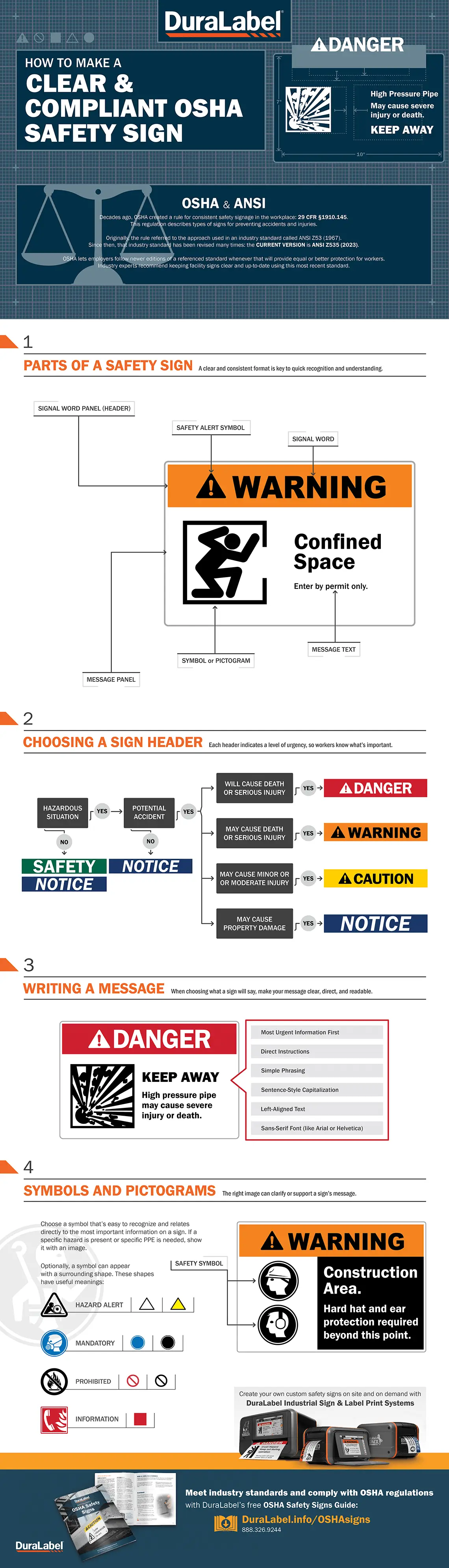
Communicate PPE locations and requirements with signs and labels
Provide training on proper PPE use—which pieces to use, when to use them, and what they protect against
KEY STATISTIC:
7,720
Number of fall protection citations issued by OSHA inspectors in 2018. It has been OSHA’s most-cited violation every year since 2011.
9 - Schedule and Perform Routine Inspections
It’s not enough to establish safe practices; the key to an enduring culture of safety is following up to ensure those efforts receive the proper follow-through.
There are two easy ways to inspect equipment and review procedures: safety inspections and safety audits.
SAFETY INSPECTION
Look for safety hazards and unsafe practices throughout a facility with a safety inspection. The inspection should:
Ensure safeguards are in place
Look for hazards posed by equipment and machinery
Test for hazardous samples through air, water, & other samples
Observe and identify unsafe work practices
SAFETY AUDIT
Evaluate your organization’s broader safety programs and practices with a safety audit. An audit should:
Measure the effects of—and collect information about—a safety program’s efficacy
Examine whether the program meets the company’s stated goals
Study and research safety training and response efforts
GOOD TO KNOW
Reviewing best practices and safety programs doesn’t just keep workers safe; it’s good business.
$1,000,000,000 *weekly on workers’ compensation costs
$170,000,000,000 Yearly costs to businesses for workplace injuries, illnesses, & deaths
*OSHA Estimates
10 - Expand Visual Communication Throughout Your Facility
No matter the industry, odds are good your workplace contains any number of hazards.
A few common hazards include:
Electrical equipment poses arc flash risks, and workers can be injured when LOCKOUT/TAGOUT procedures aren’t followed
Construction workers encounter height-related risks, electrocution, and FALLING OBJECTS
Warehouses struggle to KEEP PEDESTRIANS SAFE around forklifts and machinery
In most instances, visual communication can alert workers to hazards and offer best practices for staying safe:
ARC FLASH LABELS
inform employees about arc flash boundaries, PPE requirements, and more
SIGNS AND LABELS
remind workers to wear fall protection and use PPE whenever necessary
FLOOR SIGNS
improve warehouse traffic and keep workers safe in heavily-trafficked areas
EMERGENCY SIGNS
call out fire exits, first aid kits, and other potentially life-saving resources
GOOD TO KNOW
Safety signs can improve safety, promote positive work practices, and help facilities avoid hefty OSHA fines.
Maximum OSHA Penalties:
SERIOUS VIOLATIONS:
$13,260 per violation
WILLFUL OR REPEATED VIOLATIONS:
$132,598 per violation as of Jan. 23, 2019
DuraLabel® 888.326.9244 | DuraLabel.com