<img height="1" width="1" style="display:none" src="https://www.facebook.com/tr?id=672348691155252&amp;ev=PageView&amp;noscript=1">
Skip to content

Electrical Safety Boundaries

Updated on: February 5, 2026 1 MINUTE READ Published on: Feb 03, 2023

The National Fire Protection Association (NFPA) recommends a series of protective boundaries around live electrical equipment. These boundaries, defined in the NFPA 70E standard, provide a simple and effective way to protect workers from the hazards of arc flash and electric shock.

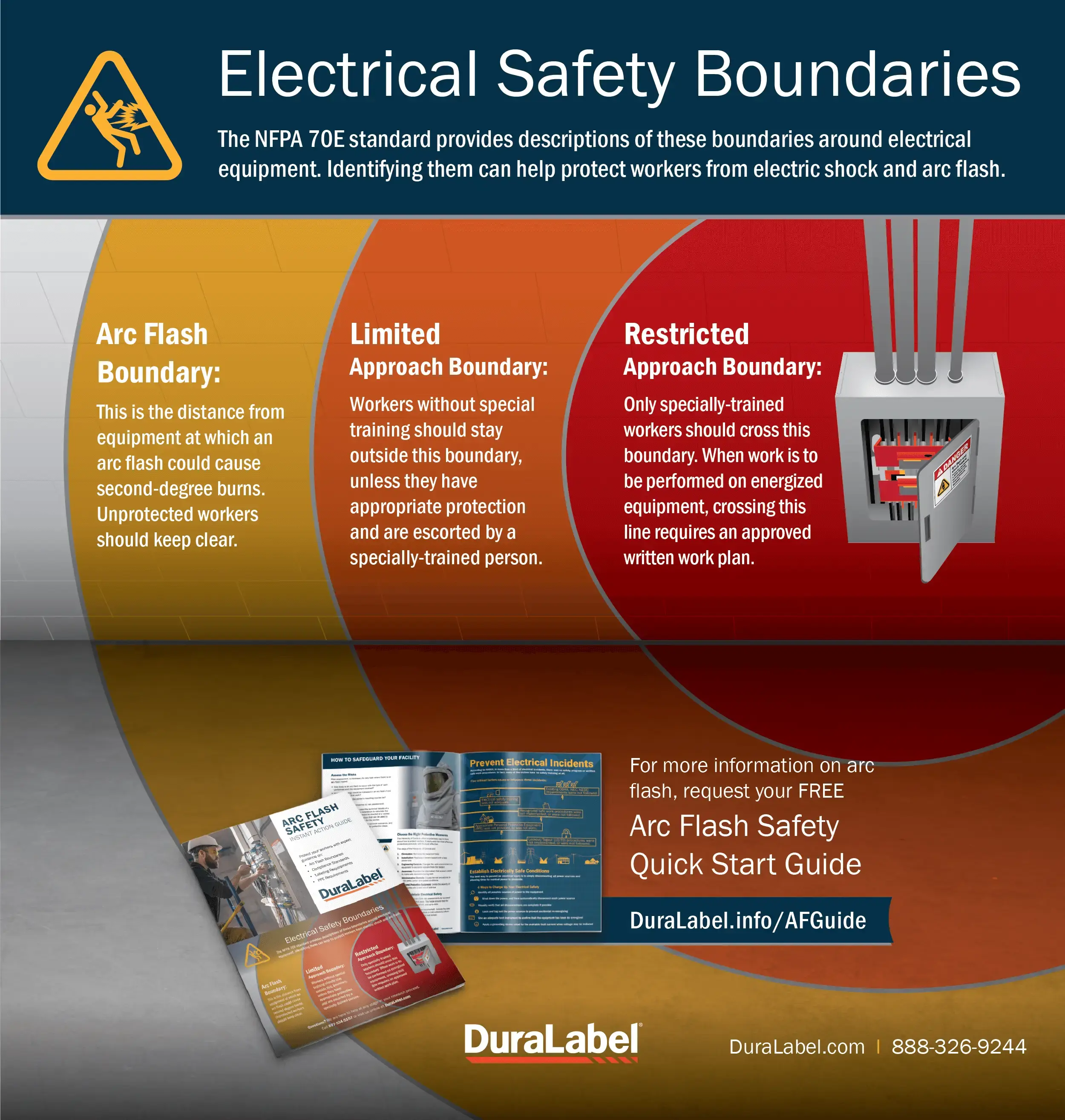
While different equipment will have these boundaries placed at different distances, each boundary always serves the same purpose. This infographic shows the differences between boundaries, helping you and your workers stay safe around powered electrical equipment.
 

Electrical Safety Boundaries

Infographic Transcription

The NFPA 70E standard provides descriptions of these boundaries around electrical equipment. Identifying them can help protect workers from electric shock and arc flash.

Arc Flash Boundary:
This is the distance from equipment at which an arc flash could cause second-degree burns. Unprotected workers should keep clear.

Limited Approach Boundary:
Workers without special training should stay outside this boundary, unless they have appropriate protection and are escorted by a specially-trained person.

Restricted Approach Boundary:
Only specially-trained workers should cross this boundary. When work is to be performed on energized equipment, crossing this line requires an approved written work plan.

For more information on arc flash, request your FREE
Arc Flash Safety
Quick Start Guide

DuraLabel.info/AFGuide

DuraLabel
DuraLabel.com | 888-326-9244

Arc Flash Quick Start Guide

Get the Free Arc Flash Quick Start Guide

Learn key steps to arc flash safety and ensure compliance with NFPA 70E standards.


Get Started

Print Your Own Signs

Free Label Design Software

Free Labeling Samples