.png)
DuraLabel®
FOOD SAFETY
PROCESSING & MANUFACTURING
Infographic Transcription
RISKS & SOLUTIONS
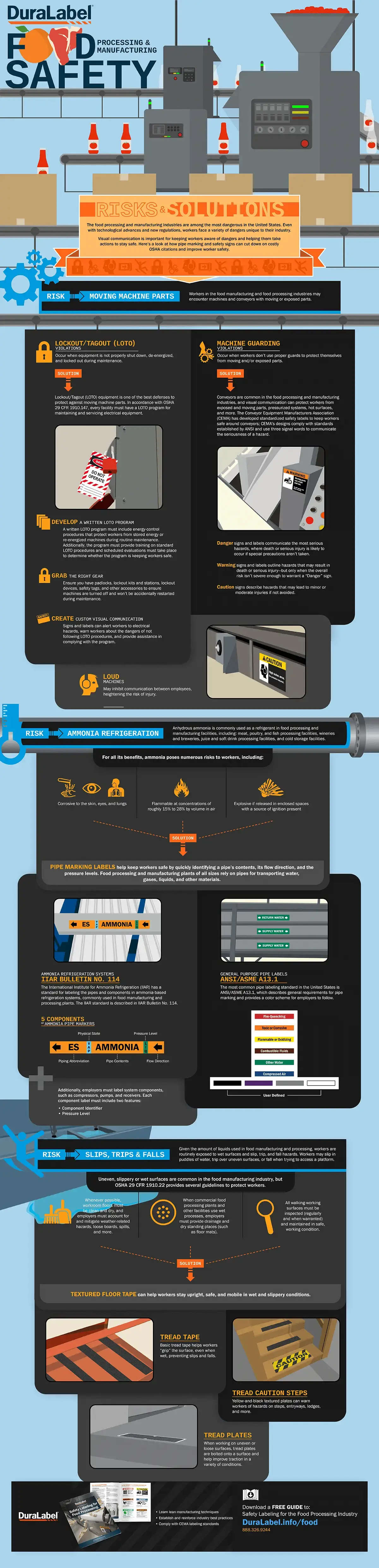
The food processing and manufacturing industries are among the most dangerous in the United States. Even with technological advances and new regulations, workers face a variety of dangers unique to their industry.
Visual communication is important for helping workers aware of dangers and helping them take actions to stay safe. Here’s a look at how pipe marking and safety signs can cut down on costly OSHA citations and improve worker safety.
RISK: MOVING MACHINE PARTS
Workers in the food manufacturing and food processing industries may encounter machines and conveyors with moving or exposed parts.
LOCKOUT/TAGOUT (LOTO)
VIOLATIONS
Occur when equipment is not properly shut down, de-energized, and locked out during maintenance.
SOLUTION
Lockout/Tagout (LOTO) equipment is one of the best defenses to prevent contact moving machine parts. In accordance with OSHA 29 CFR 1910.147, every facility must have a LOTO program for maintaining and servicing electrical equipment.
DEVELOP A WRITTEN LOTO PROGRAM
A written LOTO program must include energy-control procedures that protect workers from stored energy or re-energized machines during routine maintenance. Additionally, the program must provide training on standard LOTO procedures and scheduled evaluations must take place to determine whether the program is keeping workers safe.
GRAB THE RIGHT GEAR
Ensure you have padlocks, lockout hasps and stations, lockout devices, safety tags, and other accessories to ensure machines are turned off and won’t be accidentally restarted during maintenance.
CREATE CUSTOM VISUAL COMMUNICATION
Signs and labels can alert workers to electrical hazards, warn workers about the dangers of not following LOTO procedures, and provide assistance in complying with the program.
LOUD MACHINES
May inhibit communication between employees, heightening the risk of injury.
MACHINE GUARDING
VIOLATIONS
Occur when workers don’t use proper guards to protect themselves from moving and/or exposed parts.
SOLUTION
Conveyors are common in the food processing and manufacturing industries, and visual communication can protect workers from exposed and moving parts, pinch points, nip points and more. The Conveyor Equipment Manufacturers Association (CEMA) has developed standardized safety labels to keep workers safe around conveyors; CEMA’s designs comply with standards established by ANSI and use three signal words to communicate the seriousness of a hazard.
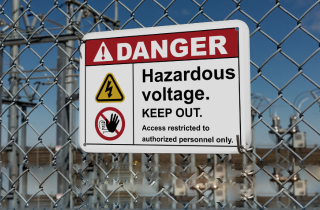
Danger signs and labels communicate the most serious hazards, where death or serious injury is likely to occur if proper precautions aren’t taken.
Warning signs and labels outline hazards that may result in death or serious injury—but only when the overall risk isn’t severe enough to warrant a “Danger” sign.
Caution signs describe hazards that may lead to minor or moderate injuries if not avoided.
RISK: AMMONIA REFRIGERATION
Anhydrous ammonia is commonly used as a refrigerant in food processing and manufacturing facilities, including meat, poultry, and fish processing facilities, wineries and breweries, juice and soft drink processing facilities, and cold storage facilities.
For all its benefits, ammonia poses numerous risks to workers, including:
- Corrosive to the skin, eyes, and lungs
- Flammable at concentrations of roughly 15% to 28% by volume in air
- Explosive if released in enclosed spaces with a source of ignition present
SOLUTION
PIPE MARKING LABELS
PIPE MARKING LABELS help keep workers safe by quickly identifying a pipe’s contents, its flow direction, and the pressure levels. Food processing and manufacturing plants of all sizes rely on pipes for transporting water, gases, liquids, and other materials.
AMMONIA REFRIGERATION SYSTEMS — IIAR BULLETIN NO. 114
The International Institute for Ammonia Refrigeration (IIAR) has a standard for labeling the pipes and components in ammonia-based refrigeration systems, commonly used in food manufacturing and processing plants. This IIAR standard is described in IIAR Bulletin No. 114.
5 COMPONENTS OF AMMONIA PIPE MARKERS
- Physical State
- Pressure Level
- Piping Abbreviation
- Pipe Contents
- Flow Direction
Additionally, employers must label system components, such as compressors, pumps, and receivers. Each component label must include two features:
- Component Identifier
- Pressure Level
GENERAL PURPOSE PIPE LABELS — ANSI/ASME A13.1
The most common pipe labeling standard in the United States is ANSI/ASME A13.1, which describes general requirements for pipe marking and provides a color scheme for employees to follow.
Color scheme:
- Fire-Quenching
- Toxic or Corrosive
- Flammable or Oxidizing
- Combustible Fluids
- Other Water
- Compressed Air
- User Defined
RISK: SLIPS, TRIPS & FALLS
Given the amount of liquids used in food manufacturing and processing, workers are routinely exposed to wet surfaces and slip, trip, and fall hazards. Workers may slip in puddles of water, trip over uneven surfaces, or fall when trying to access a platform.
Uneven, slippery or wet surfaces are common in the food manufacturing industry, but OSHA 29 CFR 1910.22 provides several guidelines to protect workers.
- Whenever possible, working surfaces must be clean and dry, and employers must account for and mitigate weather-related hazards, loose boards, spills, and more.
- When commercial food processing plants and other facilities use wet processes, employers must provide drainage and dry standing places (such as floor mats).
- All walking-working surfaces must be inspected regularly and when warranted, and maintained in safe, working condition.
SOLUTION
TEXTURED FLOOR TAPE
TEXTURED FLOOR TAPE can help workers stay upright, safe, and mobile in wet and slippery conditions.
TREAD TAPE
Basic tread tape helps workers “grip” the surface, even when wet, preventing slips and falls.
TREAD CAUTION STEPS
Yellow and black, textured plates can warn workers of hazards on steps, entryways, ledges, and more.
TREAD PLATES
When working on uneven or loose surfaces, tread plates are bolted onto a surface and help improve traction in a variety of conditions.
DuraLabel
- Learn lean manufacturing techniques
- Establish and enforce industry best practices
- Comply with OSHA labeling standards
Download a FREE GUIDE to:
Safety Labeling for the Food Processing Industry
DuraLabel.Info/food
866.326.9244