.png)
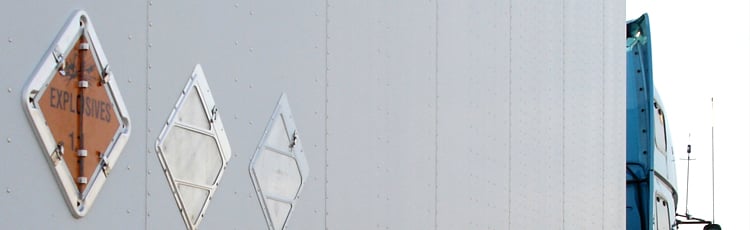
Truck trailer with DOT hazmat placard holders illustrating regulated hazardous materials transportation labeling and compliance signage.
When Are DOT Labels Required?
Department of Transportation (DOT) labels are required when shipping hazardous materials that fall under U.S. Department of Transportation hazardous materials regulations. These hazmat labels identify hazard class, handling precautions, and shipping requirements so carriers and responders can manage risk during transport. Department of Transportation labels are a core part of compliant hazmat shipping labels for packages, freight, and bulk containers.
49 CFR 172.400 specifies that DOT Labels must be used for hazardous materials when they are being transported. It requires that any person who offers a hazardous material for transportation must label the package or containment device. Labels may also be affixed to packages when they not specifically required by regulations, provided each label represents a hazard of the material contained in the package.
The OSHA Hazard Communication Standard requires that GHS labels be applied on all hazardous material containers. The DOT labels discussed here do not meet GHS requirements, and are required by the DOT in addition to GHS labels. These labels must meet the DOT labeling specifications given in 49 CFR 172 section 400. If you are shipping hazardous materials, you should be familiar with the DOT labeling requirements (49 CFR 172.400) for the materials you are shipping.
The sections below explain when DOT labeling applies, which shipments need hazmat shipping labels, and how to avoid common compliance mistakes:
-
When DOT labels apply based on hazard class and packaging
-
How department of transportation labels differ from workplace labels
-
Where hazmat shipping labels must be placed and kept visible
-
Common labeling errors that cause delays or violations
Next, we will explain which materials qualify as hazardous for shipping and how DOT hazard classes determine the required labels.
Hazmat Labels DOT Label Durability Requirements
172.407(a) requires that all Department of Transportation labels be durable and weather resistant. All DOT labels must be able to withstand, without deterioration or a substantial change in color, a 30-day exposure to the worst case conditions that can result during transportation of the container.
Outdoor exposure is a tough on hazmat shipping labels. Sun can fade printing, moisture can weaken adhesives, and wind and abrasion can damage edges and surfaces. For shipping environments, label materials should be selected for durability and resistance to weather, chemicals, and handling. DuraLabel offers vinyl supplies designed for harsh conditions, with warranty coverage for the supplies and labels produced using the system.
Hazmat Shipping Labels DOT Label Design Specifications
Sections 172.411 through 172.448 show the designs for specific types of department of transportation labels. The printing, inner border and symbols shown in these designs must be used. DOT labels must be diamond shaped, at least 3.9 inches (100mm) on each side. There must be a solid line inner border, located 0.2 to 0.25 inches (5.0 to 6.3 mm) from the edge of the label.
DOT labels must have the hazard class number, or the division number, printed in a font that is at least 6.3 mm (0.25 inches) and not greater than 12.7 mm (0.5 inches) in height. When text identifying the hazard is displayed on a label, the label name must be shown in letters measuring at least 7.6 mm (0.3 inches) in height. For materials that are spontaneously combustible, or that are dangerous when wet, the words "Spontaneously" and "When Wet" must be shown in letters measuring at least 5.1 mm (0.2 inches) in height.
The symbol printed on each DOT label must be proportionate in size as shown in the 172.411 through 172.448 examples. If the label has a green, red or blue background, the text, numbers and symbol should be printed in white. Otherwise the printing should be in black. These design rules help ensure hazmat labels remain readable and standardized across carriers and shipments.
All of the colors must be able to withstand, without substantial change, a 72-hour fadeometer test and all colors me match those specified in 49 CFR 172. The following Pantone colors may be used:
Red - Use PANTONE186 U
Orange - Use PANTONE 151 U
Yellow - Use PANTONE 109 U
Green - Use PANTONE 335 U
Blue - Use PANTONE 285 U
Purple - Use PANTONE 259 U
DOT Label Background Colors and Approved Pantone Matches
| DOT Label Color | Common DOT Label Use | Approved Pantone Color (49 CFR 172) |
|---|---|---|
| Red | Flammable Gas, Flammable Liquid | PANTONE 186 U |
| Orange | Explosives, Cargo Aircraft Only | PANTONE 151 U |
| Yellow | Oxidizers, Organic Peroxides | PANTONE 109 U |
| Green | Non-Flammable Gas | PANTONE 335 U |
| Blue | Dangerous When Wet | PANTONE 285 U |
| Purple | Specialized hazard classes | PANTONE 259 U |
DOT Labels - Design Specifications
The following is an overview summary of the DOT label design specifications given in 49 CFR 172. For the complete design specifications, please see those regulations.
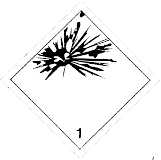
172.411 - EXPLOSIVE
Except for size and color, the EXPLOSIVE 1.1, EXPLOSIVE 1.2 and EXPLOSIVE 1.3 DOT labels must be as follows:
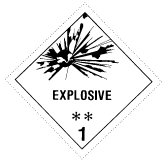
The background color on the EXPLOSIVE 1.1, EXPLOSIVE 1.2 and EXPLOSIVE 1.3 labels must be orange. The "**" must be replaced with the appropriate division number and compatibility group letter. The compatibility group letter must be the same size as the division number and must be shown as a capitalized Roman letter.
Except for size and color, the EXPLOSIVE 1.4, EXPLOSIVE 1.5 and EXPLOSIVE 1.6 DOT labels must be as follows:
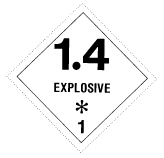
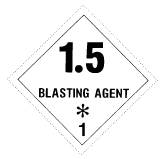
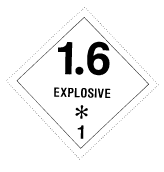
The background color on the EXPLOSIVE 1.4, EXPLOSIVE 1.5 and EXPLOSIVE 1.6 label must be orange. The "*" must be replaced with the appropriate compatibility group. The compatibility group letter must be shown as a capitalized Roman letter. Division numbers must measure at least 30 mm (1.2 inches) in height and at least 5 mm (0.2 inches) in width.
An EXPLOSIVE subsidiary label is required for materials identified in Column (6) of the Hazard Materials Table as having an explosive subsidiary hazard. The division number or compatibility group letter may be displayed on the subsidiary hazard label. Except for size and color, the EXPLOSIVE subsidiary label must be as follows:
172.415 NON-FLAMMABLE GAS label
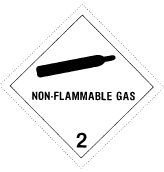
The background color on the NON-FLAMMABLE GAS label must be green.
172.416 POISON GAS label
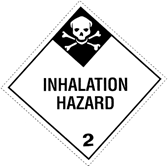
The background on the POISON GAS label and the symbol must be white. The background of the upper diamond must be black and the lower point of the upper diamond must be 14 mm (0.54 inches) above the horizontal center line.
172.417 FLAMMABLE GAS label
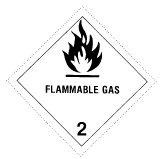
The background color on the FLAMMABLE GAS label must be red.
172.419 FLAMMABLE LIQUID label
[]
The background color on the FLAMMABLE LIQUID label must be red.
172.420 FLAMMABLE SOLID label
[]
The background on the FLAMMABLE SOLID label must be white with vertical red stripes equally spaced on each side of a red stripe placed in the center of the label. The red vertical stripes must be spaced so that, visually, they appear equal in width to the white spaces between them. The symbol (flame) and text (when used) must be overprinted. The text "FLAMMABLE SOLID" may be placed in a white rectangle.
172.422 SPONTANEOUSLY COMBUSTIBLE label
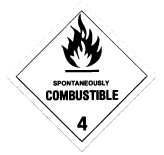
The background color on the lower half of the SPONTANEOUSLY COMBUSTIBLE label must be red and the upper half must be white.
172.423 DANGEROUS WHEN WET label
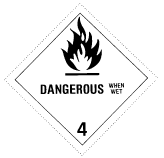
The background color on the DANGEROUS WHEN WET label must be blue.
172.426 OXIDIZER label
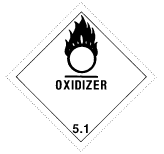
The background color on the OXIDIZER label must be yellow.
172.427 ORGANIC PEROXIDE label
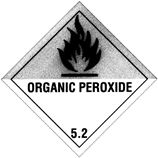
The background on the ORGANIC PEROXIDE label must be red in the top half and yellow in the lower half.
172.429 POISON INHALATION HAZARD label
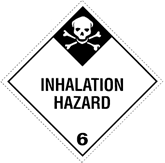
The background on the POISON INHALATION HAZARD label and the symbol must be white. The background of the upper diamond must be black and the lower point of the upper diamond must be 14 mm (0.54 inches) above the horizontal center line.
172.430 POISON label
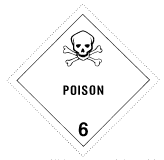
The background on the POISON label must be white. The word "TOXIC" may be used in lieu of the word "POISON".
172.432 INFECTIOUS SUBSTANCE label
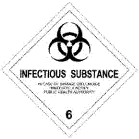
The background on the INFECTIOUS SUBSTANCE label must be white. Labels conforming to requirements in place on August 18, 2011 may continue to be used until October 1, 2014.
172.436 RADIOACTIVE WHITE-I label
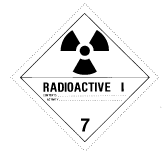
The background on the RADIOACTIVE WHITE-I label must be white. The printing and symbol must be black, except for the "I" which must be red.
172.436 RADIOACTIVE YELLOW-II label
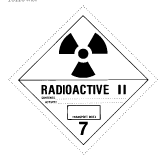
The background color on the RADIOACTIVE YELLOW-II label must be yellow in the top half and white in the lower half. The printing and symbol must be black, except for the "II" which must be red.
172.436 RADIOACTIVE YELLOW-III label
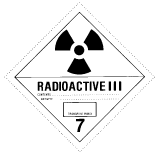
The background color on the RADIOACTIVE YELLOW-III label must be yellow in the top half and white in the lower half. The printing and symbol must be black, except for the "III" which must be red.
172.441 FISSILE label
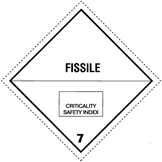
The background color on the FISSILE label must be white.
172.442 CORROSIVE label
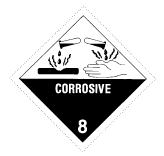
The background on the CORROSIVE label must be white in the top half and black in the lower half.
172.446 CLASS 9 label
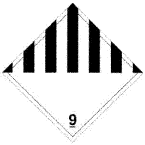
The background on the CLASS 9 label must be white with seven black vertical stripes on the top half. The black vertical stripes must be spaced, so that, visually, they appear equal in width to the six white spaces between them. The lower half of the label must be white with the class number "9" underlined and centered at the bottom. The solid horizontal line dividing the lower and upper half of the label is optional.
Labels conforming to requirements in place on August 18, 2011 may continue to be used until October 1, 2014.
172.448 CARGO AIRCRAFT ONLY label
The CARGO AIRCRAFT ONLY label must be black on an orange background. A CARGO AIRCRAFT ONLY label conforming to the specifications in this section and in 172.407(c)(2) in effect on October 1, 2008, may be used until January 1, 2013.
172.450 EMPTY label
Each side must be at least 6 inches (152 mm.) with each letter at least 1 inch (25.4 mm.) in height. The label must be white with black printing.
The information presented in this document was obtained from sources that we deem reliable; Duralabel does not guarantee accuracy or completeness. Duralabel, Inc. makes no representations or warranties of any kind, express or implied. Users of this document should consult municipal, state, and federal code and/or verify all information with the appropriate regulatory agency.


Workplace Chemical Labels and GHS Requirements Explained
What is Chemical Labeling? Clear chemical labels help workers recognize hazards quickly, select the right ...
Read
Hazard Control Hierarchy and Lab Safety Labels for Chemical Hazards
What Are Lab Safety Labels? Lab safety labels are visual identifiers that communicate chemical and process ...
Read
CO2 Cylinder Tanks and the Art of Labeling
Dealing with dangerous substances is a major concern for any workplace. Whether it's chemicals that can burn ...
ReadTake Action
Print Your Own Signs
Free Label Design Software