OSHA
FALL PROTECTION EQUIPMENT
& FALL CLEARANCE CALCULATIONS
Infographic Transcription
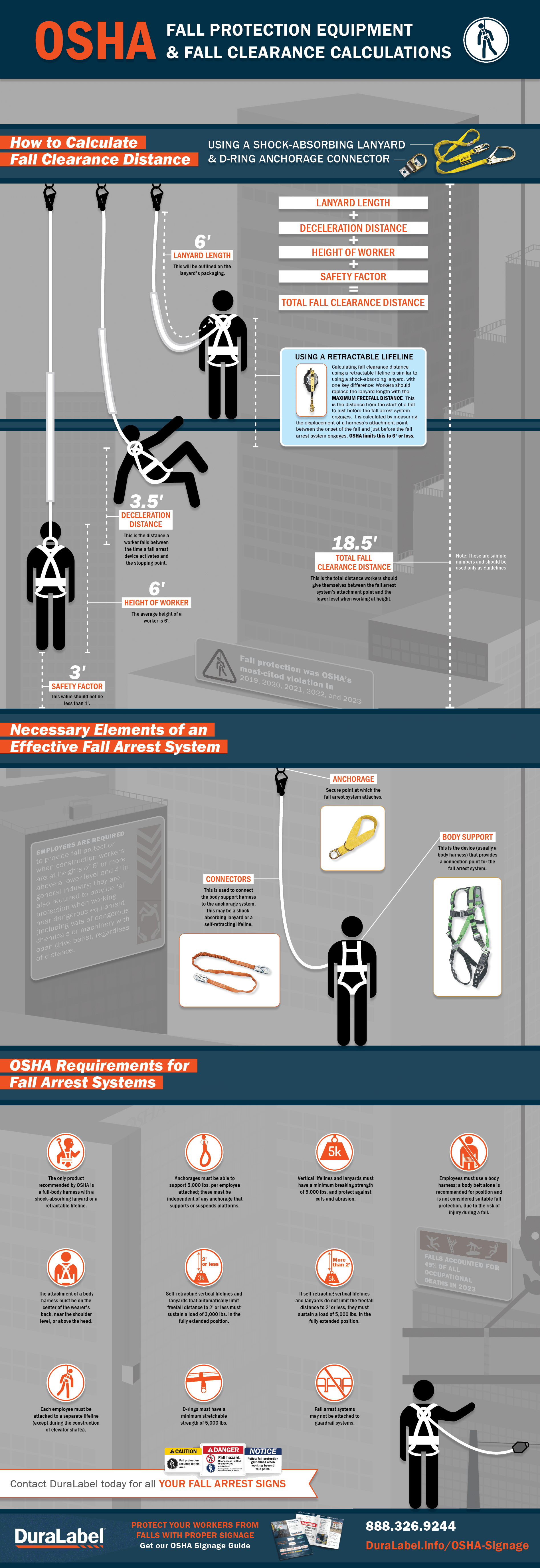
How to Calculate Fall Clearance Distance
USING A SHOCK-ABSORBING LANYARD & D-RING ANCHORAGE CONNECTOR
LANYARD LENGTH
- 6'
- This will be outlined on the lanyard’s packaging.
DECELERATION DISTANCE
- 3.5'
- This is the distance a worker falls between the time a fall arrest device activates and the stopping point.
HEIGHT OF WORKER
- 6'
- The average height of a worker is 6'.
SAFETY FACTOR
- 3'
- This value should not be less than 3'.
TOTAL FALL CLEARANCE DISTANCE
- 18.5'
- This is the total distance workers should give themselves between the fall arrest system’s attachment point and the lower level when working at height.
Formula shown:
LANYARD LENGTH
- DECELERATION DISTANCE
- HEIGHT OF WORKER
- SAFETY FACTOR
= TOTAL FALL CLEARANCE DISTANCE
Note: These are sample numbers and should be used only as guidelines.
Using a Retractable Lifeline
- Calculation of fall clearance distance using a retractable lifeline is similar to using a shock-absorbing lanyard, with one key difference: Worker’s travel distance is the lanyard length with the MAXIMUM FREEFALL DISTANCE.
- This is the distance from the start of a fall to just below the fall arrest mechanism.
- OSHA limits this to 6' or less.
Fall protection was OSHA’s most-cited violation in 2019, 2020, 2021, 2022, and 2023.
Necessary Elements of an Effective Fall Arrest System
ANCHORAGE
- Secure point at which the fall arrest system attaches.
CONNECTORS
- This is used to connect the body support harness to the anchorage system.
- This may be a shock-absorbing lanyard or a self-retracting lifeline.
BODY SUPPORT
- This is the device (usually a body harness) that provides a connection point for the fall arrest system.
OSHA Requirements for Fall Arrest Systems
- The only product recommended by OSHA is a full-body harness and a shock-absorbing lanyard or retractable lifeline.
- Anchorages must be able to support 5,000 lbs. per employee attached; they must be independent of any anchorage that supports or suspends platforms.
- Vertical lifelines and lanyards must have a minimum breaking strength of 5,000 lbs. and protect against cuts and abrasion.
- Employees must use a body harness; a body belt alone is recommended for positioning and is not considered suitable fall protection, due to the risk of injury during a fall.
- The attachment of a body harness must be on the center of the wearer’s back, near the shoulder level, or above the head.
- Each employee must be attached to a separate lifeline (except during the construction of elevator shafts).
- Self-retracting vertical lifelines and lanyards that automatically limit freefall distance to 2' or less must sustain a load of 3,000 lbs. in the fully extended position.
- If self-retracting vertical lifelines and lanyards do not limit the freefall distance to 2' or less, they must sustain a load of 5,000 lbs. in the fully extended position.
- D-rings must have a minimum strength of 5,000 lbs.
- Fall arrest systems may not be attached to guardrail systems.
Contact DuraLabel today for all YOUR FALL ARREST SIGNS
DuraLabel
PROTECT YOUR WORKERS FROM FALLS WITH PROPER SIGNAGE
Get our OSHA Signage Guide
888.326.9244
DuraLabel.info/OSHA-Signage
.png)