KANBAN
Infographic Transcription
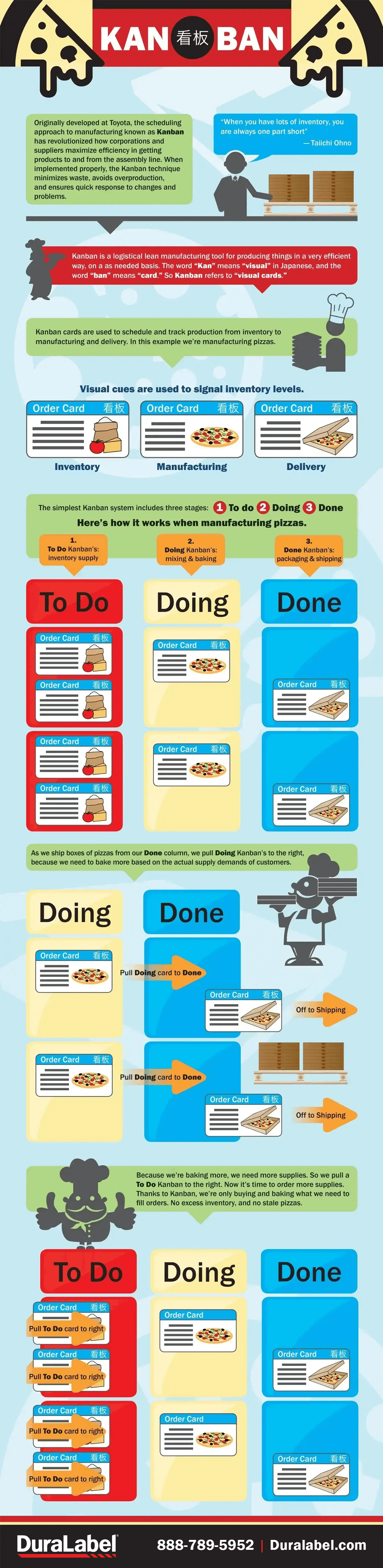
Originally developed at Toyota, the scheduling approach to manufacturing known as Kanban has revolutionized how corporations and suppliers maximize efficiency in getting products to and from the assembly line. When implemented properly, the Kanban technique minimizes waste, avoids overproduction, and ensures quick response to changes and problems.
“When you have lots of inventory, you are always one part short”
— Taiichi Ohno
Kanban is a logistical lean manufacturing tool for producing things in a very efficient way, on a as needed basis. The word “Kan” means “visual” in Japanese, and the word “ban” means “card.” So Kanban refers to “visual cards.”
Kanban cards are used to schedule and track production from inventory to manufacturing and delivery. In this example we’re manufacturing pizzas.
Visual cues are used to signal inventory levels.
Order Card— Inventory
Order Card — Manufacturing
Order Card — Delivery
The simplest Kanban system includes three stages: 1 To do 2 Doing 3 Done
Here’s how it works when manufacturing pizzas.
- To Do Kanban’s: inventory supply
- Doing Kanban’s: mixing & baking
- Done Kanban’s: packaging & shipping
To Do
Doing
Done
As we ship boxes of pizzas from our Done column, we pull Doing Kanban’s to the right, because we need to bake more based on the actual supply demands of customers.
Doing
Done
Pull Doing card to Done
Off to Shipping
Pull Doing card to Done
Off to Shipping
Because we’re baking more, we need more supplies. So we pull a To Do Kanban to the right. Now it’s time to order more supplies. Thanks to Kanban, we’re only buying and baking what we need to fill orders. No excess inventory, and no stale pizzas.
To Do
(arrow labels on cards) Pull To Do card to right
(arrow labels on cards) Pull To Do card to right
(arrow labels on cards) Pull To Do card to right
(arrow labels on cards) Pull To Do card to right
Doing
Done
DuraLabel
888-789-5952 | Duralabel.com
.png)
%20(1)%20(2)%20(1).webp)