PIPE MARKING ANSI/ASME A13.1 2023 Standard
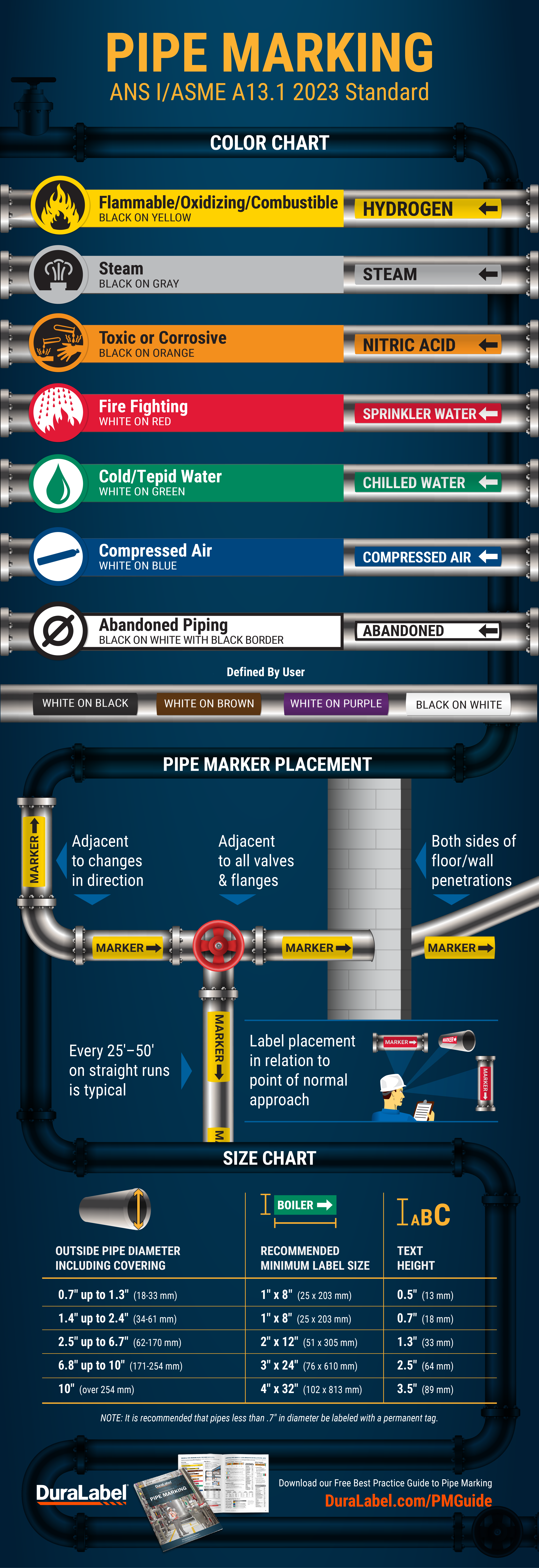
Infographic Transcription
What are the Official Pipe Marking Color Codes for 2026?
Flammable/Oxidizing/Combustible
BLACK ON YELLOW
Example: HYDROGEN
Steam
BLACK ON GRAY
Example: STEAM
Toxic or Corrosive
BLACK ON ORANGE
Example: NITRIC ACID
Fire Fighting
WHITE ON RED
Example: SPRINKLER WATER
Cold/Tepid Water
WHITE ON GREEN
Example: CHILLED WATER
Compressed Air
WHITE ON BLUE
Example: COMPRESSED AIR
Abandoned Piping
BLACK ON WHITE WITH BLACK BORDER
Example: ABANDONED
Defined By User
WHITE ON BLACK
WHITE ON BROWN
WHITE ON PURPLE
BLACK ON WHITE
Where Must Pipe Markers Be Placed to Comply with OSHA 1910.145?
Adjacent to changes in direction
Adjacent to all valves & flanges
Both sides of floor/wall penetrations
Every 25'-50' on straight runs is typical
Label placement in relation to point of normal approach
How is Pipe Marker Size Determined by ASME A13.1?
| OUTSIDE PIPE DIAMETER INCLUDING COVERING |
RECOMMENDED MINIMUM LABEL SIZE |
TEXT HEIGHT |
| 0.7" up to 1.3" (18-33 mm) |
1" x 8" (25 x 203 mm) |
0.5" (13 mm) |
| 1.4" up to 2.4" (34-61 mm) |
1" x 8" (25 x 203 mm) |
0.7" (18 mm) |
| 2.5" up to 6.7" (62-170 mm) |
2" x 12" (51 x 305 mm) |
1.3" (33 mm) |
| 6.8" up to 10" (171-254 mm) |
3" x 24" (76 x 610 mm) |
2.5" (64 mm) |
| 10" (over 254 mm) |
4" x 32" (102 x 813 mm) |
3.5" (89 mm) |
| NOTE: It is recommended that pipes less than .7" in diameter be labeled with a permanent tag. |
Understanding the Visual Science & Compliance Logic Behind Pipe Marking
The effectiveness of pipe marking standards is rooted in human factors and visual cognition. The color-coding system, for instance, leverages the brain's ability to quickly associate colors with specific emotions or meanings. Red, universally recognized as a signal for danger, is used for fire-fighting fluids, while yellow, often associated with caution, is used for flammable materials. This immediate visual cue allows workers to assess risk and take necessary precautions without having to read the label's text. The standardized placement and size of labels ensure that this critical information is consistently visible from all angles and distances, a key principle of effective safety communication.
Expert Field Note:
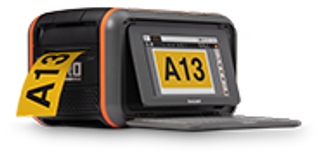
Expert Field Note: When selecting pipe markers for harsh industrial environments, material durability is as crucial as compliance. In facilities with high humidity, chemical exposure, or extreme temperatures, standard labels can quickly fade, peel, or become unreadable. For these applications, I recommend using high-performance vinyl labels, such as those offered by DuraLabel. Their Premium Vinyl Tapes are specifically engineered to withstand these challenging conditions, ensuring that your pipe markers remain legible and compliant for years to come. For large-scale pipe marking projects, consider investing in a portable label printer like the Toro Max for on-demand printing and application.
DuraLabel
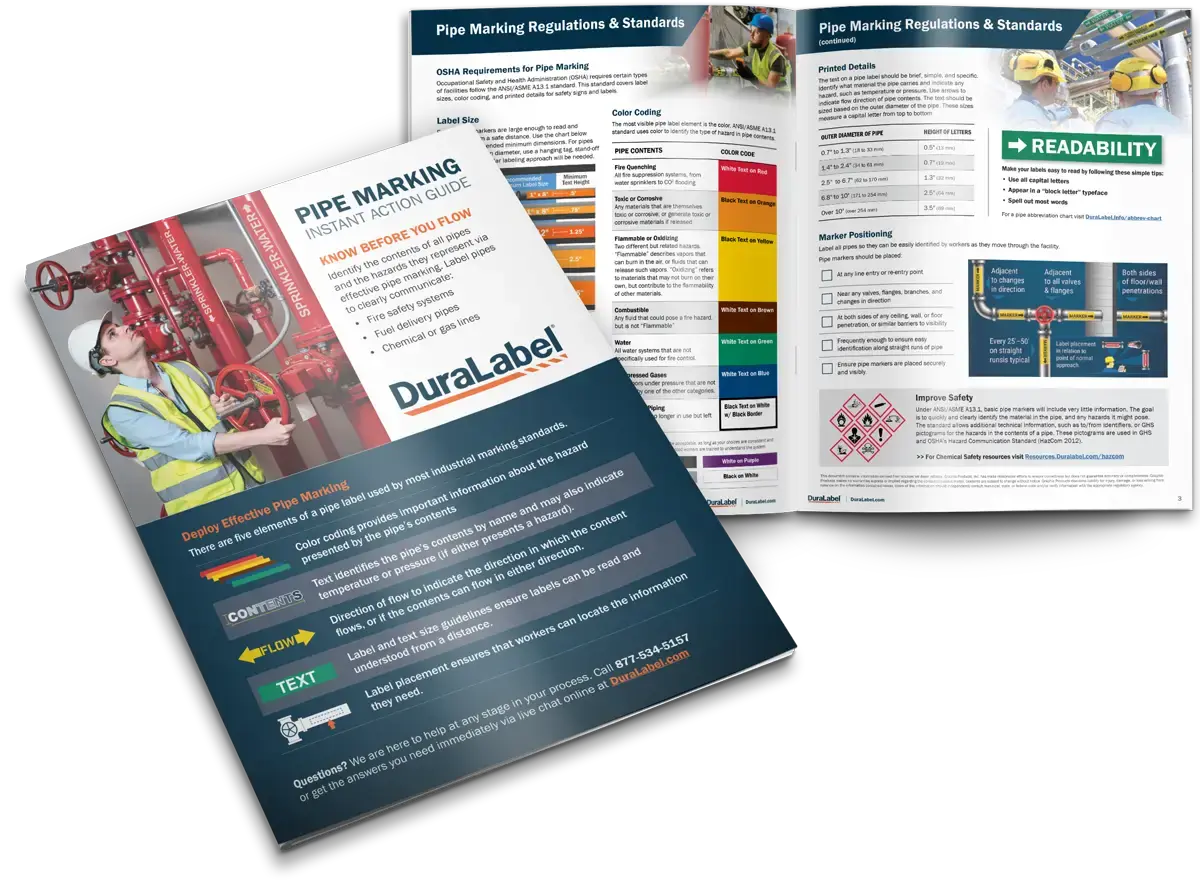
Download our Free Best Practice Guide to Pipe Marking
DuraLabel.com/PMGuide
.png)