.png)
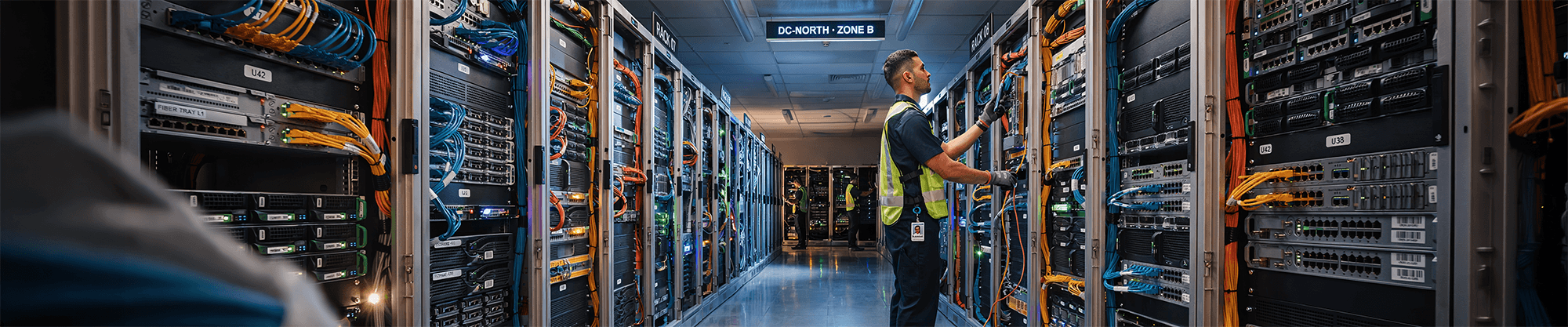
Clear data center labels help technicians quickly identify equipment and maintain reliable operations.
How Do Data Center Labels Improve Uptime and Organization?
Data center labels help technicians quickly identify cables, equipment, power sources, and network connections throughout a facility. In complex data centers, proper labeling reduces human error, supports faster troubleshooting, and helps teams minimize downtime during maintenance or emergencies. A well-designed labeling system also improves organization, supports labeling standards, and gives data center managers the information they need to maintain reliable operations.
Why Proper Labeling Matters in Modern Data Centers
A single unlabeled cable can create major problems during a network outage. When technicians must trace connections manually, valuable time disappears. Every minute spent searching for equipment, verifying connections, or identifying power sources increases the risk of service interruptions. In facilities that support cloud computing, healthcare systems, financial transactions, or critical communications, delays can have significant consequences.
Proper labeling creates a visual roadmap for the entire network infrastructure. Labels help teams identify equipment locations, cable pathways, rack positions, patch panels, power distribution units, and other critical assets without guesswork.
Many facilities invest heavily in servers, cooling systems, and security controls while overlooking one of the simplest ways to improve efficiency. Data center labels provide immediate visibility into complex systems and support a more organized data center operation.
When a technician opens a rack and finds clearly marked equipment, troubleshooting becomes faster and more accurate. The result is less confusion, improved productivity, and reduced operational risk.
Data Center Cable Labeling Helps Teams Quickly Identify Critical Connections
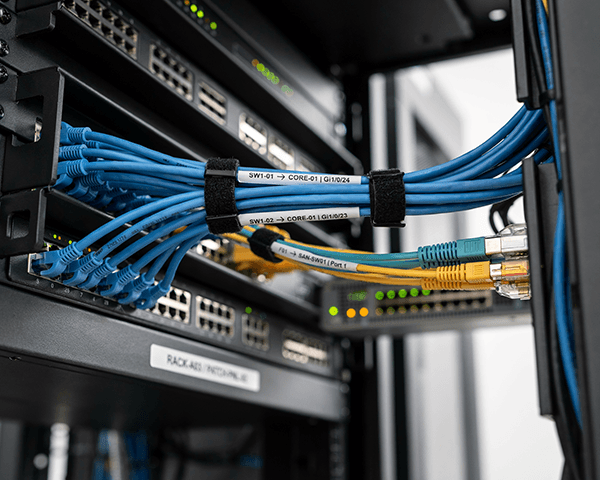
Clearly labeled network cables reduce troubleshooting time and improve organization throughout the data center.
Data centers contain thousands of cables connecting servers, switches, routers, storage devices, and telecommunications equipment. Without clear identification, tracing a single connection can become a time-consuming process.
Effective cable labeling allows technicians to:
- Quickly identify cable origins and destinations
- Reduce the likelihood of disconnecting the wrong system
- Save time during maintenance and upgrades
- Support faster incident response
- Improve documentation accuracy
For example, a technician responding to a failed network switch may need to locate dozens of connected cables immediately. Clear cable labels allow the technician to isolate the affected connections without disrupting unrelated systems.
This level of visibility becomes increasingly important as facilities grow. Many modern organizations operate complex data centers containing multiple rooms, hundreds of racks, and thousands of network connections. Consistent labeling helps maintain order as infrastructure expands.
What Should Be Included in a Data Center Labeling System?
Organizations should establish standardized procedures for effectively labeling every critical component throughout the facility. Consistency helps employees understand information quickly regardless of which area they are working in.
Common applications include:
|
Label Type |
Common Use |
Benefit |
|
Cable Labels |
Network and power cables |
Helps technicians quickly identify connections and troubleshoot issues |
|
Rack Labels |
Server racks and cabinets |
Improves equipment location and organization |
|
Server Labels |
Individual servers and hardware |
Supports maintenance and asset tracking |
|
Patch Panel Labels |
Network patch panels |
Reduces connection errors and speeds up troubleshooting |
|
Power Distribution Labels |
Power supplies and distribution units |
Improves electrical identification and maintenance efficiency |
|
Asset Tags |
IT equipment and infrastructure |
Supports asset management and documentation |
|
QR Code Labels |
Equipment, racks, and assets |
Provides instant access to maintenance records and technical information |
Many facilities also incorporate QR codes into their labeling strategy. A technician can scan a label and instantly access equipment specifications, maintenance records, network diagrams, or troubleshooting procedures.
This approach helps teams work more efficiently while improving access to critical information.
The type of label used should align with the application. Equipment exposed to heat, frequent handling, or cleaning chemicals may require specialized materials designed for harsh environments. Choosing the right supply, such as DuraLabel® Premium Vinyl Label Stock, helps maintain readability over the life of the label.
Organizations should also establish labeling standards that define naming conventions, placement requirements, color coding, and formatting guidelines. Standardization reduces confusion and improves communication across departments.
How Data Center Managers Use Labels to Reduce Human Error
Human error remains one of the most common causes of downtime. Mistakes often occur when employees work under pressure, especially during outages, upgrades, or emergency repairs. A mislabeled cable or unidentified device can lead to incorrect changes that affect critical services.
Clear identification allows technicians to verify equipment before making changes. Labels provide an additional layer of confirmation that helps prevent accidental disconnections and configuration errors.
Consider a technician performing maintenance on a power distribution unit. Without clear labeling, there is a greater chance of affecting the wrong equipment. With accurate identification, the technician can verify the correct asset before proceeding.
This simple process helps reduce human error and supports safer, more reliable operations.
Labeling also improves training efforts. New employees can navigate facilities more confidently when equipment and infrastructure are clearly identified. This shortens learning curves and helps teams maintain consistent performance.
Choosing High-Quality Labels for Long-Term Performance
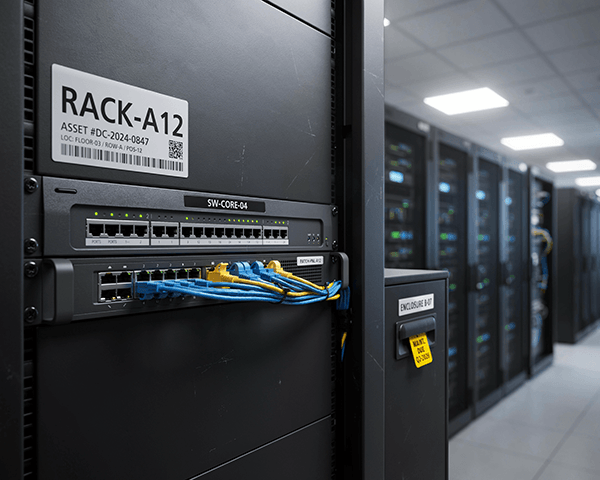
Durable rack and equipment labels improve asset identification and support long-term data center organization.
Not all labels are designed for data center environments. Standard office labels often fade, peel, or become damaged over time. Facilities need high-quality materials that remain legible throughout the life of the infrastructure.
Durability becomes especially important in areas exposed to:
- Heat generated by equipment
- Frequent maintenance activity
- Cleaning procedures
- Dust and environmental contaminants
Many facilities choose laminated labels because they provide additional protection against abrasion, moisture, and wear. Laminated labels help preserve critical information and reduce replacement costs.
Thermal transfer printing technology is another important consideration. Unlike standard desktop printing methods, thermal transfer systems produce durable, professional labels designed for industrial applications.
A long-term labeling strategy focuses on consistency, durability, and visibility. When labels remain readable for years, organizations spend less time replacing damaged identifiers and more time maintaining critical operations.
Facilities that invest in durable labeling materials often experience fewer identification issues and greater confidence in their infrastructure documentation.
Data Center Labels Support Reliability Across the Entire Facility
Whether a facility manages cloud services, enterprise applications, healthcare records, or financial transactions, reliable infrastructure depends on clear communication. Data center labels provide that communication at the point where employees need it most.
From cable labeling and asset identification to equipment tracking and maintenance documentation, labels help teams work faster and make better decisions.
Organizations that prioritize proper labeling create environments that are easier to manage, easier to maintain, and better prepared for growth. The result is improved visibility, reduced human error, and a stronger foundation for long-term operational success.
DuraLabel Products and Resources to Strengthen Data Centers
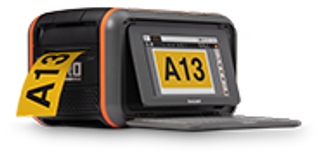
The DuraLabel Toro® Max Industrial Sign and Label System helps organizations create durable data center labels on demand. With thermal transfer printing technology and industrial-grade supplies, facilities can produce clear, professional labels for cables, racks, servers, patch panels, and other critical infrastructure. Durable label materials help maintain readability while supporting long-term performance in demanding environments. readability while supporting long-term performance in demanding environments.
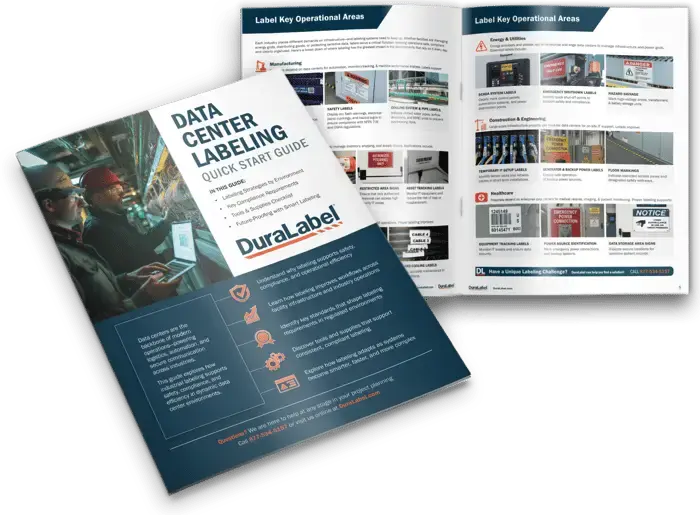
For additional guidance, download DuraLabel's free Data Center Labeling Quick Start Guide. The guide covers labeling best practices, asset identification strategies, compliance considerations, and practical recommendations for building an effective labeling program.
Need help selecting the right labeling solution for your facility? Call a DuraLabel labeling expert at 1-888-786-9223 for personalized assistance.
Read Next:
Why Upgrade to the DuraLabel Toro Max Industrial Sign and Label System
Modern ERP System Adoption and the Shift Away from Legacy Platforms

What Is TIA-942? Understanding the Data Center Infrastructure Standard
Data centers support critical services, from cloud applications and financial systems to healthcare networks ...
Read
Efficient Use of Barcoding Labels for Smarter Facility Management
With today’s technological advancements, much of the work force is searching for ways to become more ...
Read
Why Barcode Stickers Are Essential for Industrial Tracking
What Are Barcode Stickers Used For? Barcode stickers, often referred to as barcode labels in industrial ...
ReadTake Action

Print Your Own Signs
Free Label Design Software